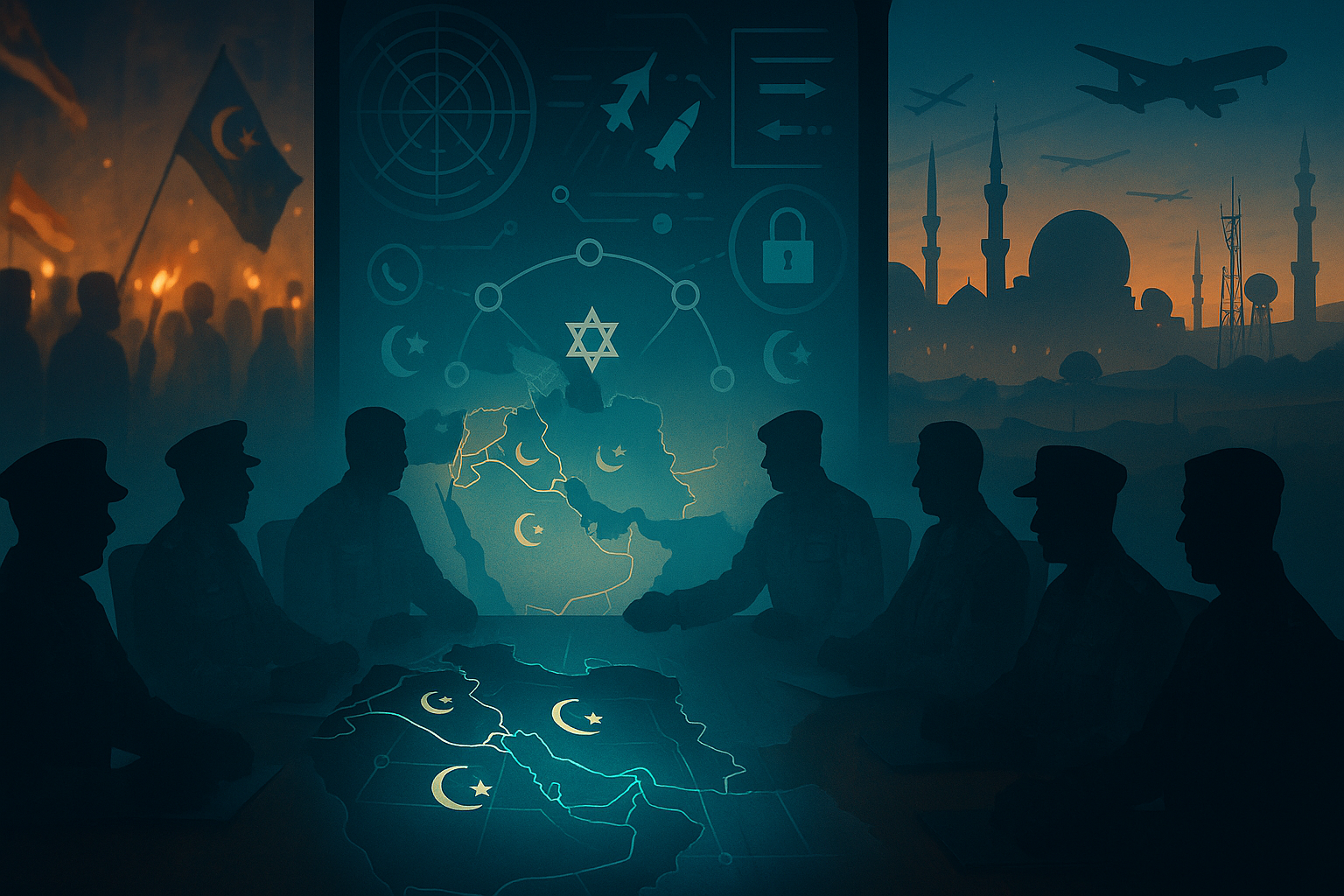
How a leak revealed a regional security web that contradicts public rhetoric on Gaza
Article by @Alex_Namaste. Follow me on Instagram.
Summary for busy readers
A leak reviewed by ICIJ and The Washington Post shows that while top Arab leaders condemned the Gaza war in the strongest terms, their militaries quietly deepened practical ties with Israel in a United States facilitated framework that spans shared radar feeds, secure communications, training on tunnel warfare, and a notional regional air and missile defense concept. The documents describe a structure called the Regional Security Construct that brought Israel together with Bahrain, Egypt, Jordan, Qatar, Saudi Arabia, and the United Arab Emirates, with Oman and Kuwait briefed as potential partners. Meetings occurred between 2022 and 2025 in Bahrain, Egypt, Jordan, Qatar, and at United States facilities.
One May 2024 conference at Al Udeid Air Base in Qatar was arranged to shield an Israeli delegation from public exposure. The collaboration coexisted with fierce public denunciations of Israeli actions. Qatar’s leadership called the Gaza campaign genocidal at the United Nations, and Saudi statements accused Israel of starvation and ethnic cleansing, even as their militaries were linked into shared regional data and planning channels that, according to the leak, were developed by United States Central Command. The partnership then hit a crisis in September 2025 after an Israeli strike in Doha killed Hamas figures and a Qatari security officer. Israel later issued an apology to Qatar, which underscores how the reality of hard security cooperation sits atop fragile political legitimacy. The story matters because it reveals how states manage two clocks at once.
One clock is public outrage and domestic politics. The other is hard security against Iran, drones, missiles, and cross border networks. The leak gives a rare inside view of how power is actually exercised behind closed doors and why secrecy can help coordination in the short term but can also erode trust if the public learns about it through a leak rather than elected oversight. ICIJ

I. The leak and the double ledger
The ICIJ team describes a pattern in which Israeli and Arab officers met repeatedly under the umbrella of United States Central Command. Over 3 years, senior figures gathered in Bahrain, Egypt, Jordan, and Qatar for planning sessions on Iran, cross border tunnels, and a shared air picture. The documents are unclassified but sensitive, and ICIJ says they verified dates, locations, and officials against Defense Department materials and open records. The picture is not rumor. It is an administrative history of quiet interoperability, reproduced in slide decks and meeting itineraries that map to public exercises and news releases. ICIJ
The Washington Post account complements the ICIJ findings and names the same circle of states. It outlines how the forum focused on countering Iran and building a real time region wide approach to threats from drones and missiles. It also reports that the coalition was shaken when Israel struck Hamas leaders in Doha in September 2025, killing several people and igniting a diplomatic storm. In the days that followed, the public narrative and the private architecture crashed into each other. The Washington Post
The paradox becomes visible when you set the leak beside official public remarks. In September, Qatar’s emir condemned what he called a genocidal war, and Saudi statements accused Israel of starvation and ethnic cleansing. The same month, the leak shows, their militaries were already plugged into a shared picture of the sky and into secure channels curated by the United States. The gap between words and wiring is the core revelation. ICIJ
II. How the wiring works
The documents describe an architecture that matured from concept to implementation. In 2022, then Central Command chief Gen. Kenneth McKenzie told senators that the entry of Israel into the Central Command area created new chances for integrated air and missile defense. That testimony foreshadowed the mechanics the leak now details. Sensors and radars from partner states began to feed United States systems. Partner officers viewed a combined picture and learned to talk to each other through a secure chat run by the United States. The pieces look technical. Their meaning is political. Shared data is shared risk and shared accountability. U.S. Central Command
Training moved in parallel to systems. A January 2025 event at Fort Campbell included sessions on underground tunnels of the kind that have defined the Gaza battlefield. Region wide exercises like Bright Star in Egypt gave planners public cover to refine habits of cooperation. The leap from multilateral live fire training to a real time fused air picture is large, but the leak suggests that this leap was underway by 2024. Photographs and official exercise materials help anchor the dates and locations named in the leak. ICIJ
The ICIJ article further notes future planning for an information fusion center and a regional cyber center with a target of late 2026. These are not cosmetic additions. A fusion node is a political commitment tucked into a technical wrapper. It presumes that the same states that denounced Israel will sit together to write standard operating procedures on data sharing, incident response, and messaging. That is the quiet revolution inside the slides. ICIJ
III. The politics of denunciation and cooperation
Public rhetoric across Arab capitals, and not only in the Gulf, turned scathing through 2024 and 2025. Qatar’s leaders used the United Nations to accuse Israel of genocide. Saudi statements used the language of starvation and ethnic cleansing. One month after those declarations, leaked files show how the same governments remained essential players in a security scheme that included Israel. The coexistence of condemnation and cooperation is not an error. It is a management of different audiences and different threat calendars. ICIJ
The political logic is not new. Since the Abraham Accords, the core of normalization has been neutral language about shared threats, chiefly Iran and its partners. Research from Chatham House documents how the accords opened lanes for security and technology exchange. Central Command leaders, first McKenzie then Kurilla, spoke openly about a priority to stitch a regional air defense fabric with Israeli participation. The new material value of the leak is that it moves the story from aspiration to calendars, airports, and room assignments. Chatham House+1
The crisis after the Doha strike became a stress test for the entire project. ICIJ reports that Israel apologized to Qatar after prompting from Washington. The apology was as much about saving face as saving function. You cannot run a shared air picture when one partner bombs the capital of another without warning. That contradiction forced the political class to confront the fact that quiet security ties cannot survive public humiliation without swift repair mechanisms. ICIJ
IV. The operational record and its limits
The Bright Star series illustrates the outer edge of what states are willing to show. In September 2025, paratroopers from many countries jumped near the Giza pyramids and posed for public domain photos. The same month, according to the leak, partners were being onboarded to secure chats and were receiving a partial air picture. Exercises are theater, and theater matters, but the backstage systems described by ICIJ are the center of gravity. The difference between a photo over Giza and a radar feed into a combined plot is the difference between ceremony and capability. DVIDS
The documents also show blind spots. United States radar and satellite focus was tuned toward expected threats from Iran and other directions. It did not provide an early warning that would have blocked the Israeli strike on Doha. Qatar’s own radars did not light up in time either. That fact underscores a principle that technologists rarely say out loud. An integrated picture does not guarantee integrated restraint. The map is shared. The triggers are not. ICIJ
Analysts quoted by ICIJ caution that while quiet military engagement can dodge political landmines, it also hides real tensions. Once exposed, the secrecy makes the backlash worse. In other words, the very confidentiality that allows cooperation to bloom can become an accelerant when things go wrong. That conclusion fits the pattern that followed the Doha strike and that now shadows plans to place cyber and information fusion on an institutional footing by 2026. ICIJ
V. Accountability after secrecy
What should oversight look like when governments run parallel tracks of rhetoric and cooperation. First, legislatures should be briefed in camera on the scope of data sharing, on the legal basis for hosting Israeli officers on bases in Arab territory, and on any rules of engagement that flow from shared situational awareness. If the system allows one party to see but not to veto an action that could drag the region into escalation, citizens deserve to know the boundaries. That demand is not an intrusion. It is democratic hygiene.
Second, the United States needs to reconcile public diplomacy with the reality that it has been the architect of the construct. The Axios record shows that integrated defense with Israeli involvement has been a stated priority since 2022. If Washington wants partners to carry public costs, it must be prepared to absorb some of those costs at home. That means clearer statements of purpose and clearer thresholds for when quiet cooperation must pause after a breach of trust, such as a strike in the capital of a partner. Axios
Third, the region will need a public doctrine that explains the difference between political normalization and military pragmatism. Reuters reporting on the Saudi rethink of a formal defense treaty after Gaza shows how fragile the bargain remains. A treaty can stall while a sensor feed continues to run. The longer that gap persists, the greater the risk that a future leak will do the work that parliaments refused to do. That is bad for legitimacy and bad for strategy. Reuters
VI. What this story changes right now
The leak pulls an invisible map into daylight. It shows that the regional security picture is no longer a thought experiment. It is a network that can help enforce a ceasefire and hostages deal in Gaza only if the political class can persuade its own publics that cooperation serves security rather than eroding dignity. The Washington Post account makes that point plain through the reporting on joint plans to support ceasefire monitoring with limited Arab deployments alongside United States personnel. That is the test that comes next. The Washington Post
It also changes how we should read the next photo of officers gathered at a hotel in Manama or Cairo. We now know that behind the glossy images there are spreadsheets that track who shares radar and who only views, who is on secure chat and who is not, who brings cyber teams and who brings political cover. The ICIJ verification process connects those spreadsheets to verifiable exercise dates and public rosters. The narrative is no longer speculative. ICIJ
Finally, it reframes the meaning of normalization. The Chatham House analysis of the Abraham Accords explains how security integration grew from a shared threat model. The leak shows that the integration moved faster and went deeper than many assumed, even as public condemnation of Gaza reached its harshest register. The task ahead is to decide whether secrecy will continue to be the default or whether elected institutions and publics will be treated as adults who can hold two truths at once. Chatham House
Key sources and documentation
ICIJ investigation with dates, locations, verification method, and details on shared data and secure communications. ICIJ
Washington Post partner story that confirms the structure, the roster of states, and the clash after the Doha strike. The Washington Post
United States Central Command testimony and briefings about integrated regional air and missile defense with Israeli participation. U.S. Central Command+1
Public record of Bright Star 25 exercises in Egypt in September 2025 that aligns with the time frame in the leak. DVIDS+1
Context on integrated defense as a stated policy priority and on the post Gaza recalibration of Saudi United States arrangements. Axios+1
Leave a Reply